Google Reviews into Revenue: The 2026 Growth Strategy
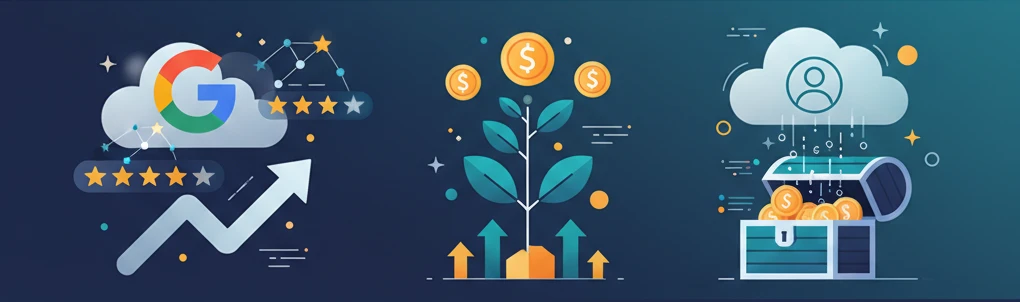
Google Reviews Strategy: Why Yours Isn’t Making Money
If you’re still treating your Google Reviews as a simple digital trophy case, you’re essentially leaving a mountain of cash on the table for your competitors to scoop up. In 2026, the game has shifted from "star counting" to Revenue Growth fueled by deep sentiment analysis and AI-driven trust signals. Most businesses are stuck in a 2022 mindset, desperately chasing a 5-star rating while ignoring the actual Business Reputation that drives a modern reviews strategy. The hard truth? A high rating with zero engagement is a dead asset. To truly understand how to turn google reviews into revenue for business, you have to stop looking at feedback as a metric and start seeing it as a sales engine.
The Death of the Passive Star Rating
Consumers are smarter than ever, and Google’s AI is even sharper. They don’t just want to see that you’re "good"; they want to see why you’re the right choice right now. The best reviews strategy for increasing customer loyalty involves moving beyond the "thanks for the review" template and into a proactive dialogue that fosters social proof and customer loyalty. If your current approach feels like a chore rather than a core growth lever, that’s exactly why your phone isn’t ringing as much as it should be. We’re entering an era where Google Reviews are the ultimate conversion tool, but only if you know how to weaponize the data hidden inside them.
Think about it: when was the last time you bought a high-ticket service based solely on a star count? Probably never. You looked for the story, the specific problem solved, and the recency of the interaction. In this guide, we’re going to dismantle the old ways and build a high-performance framework that turns every single piece of feedback into a predictable stream of income.
5 Reviews Strategy Mistakes Killing Your Local Traffic
You might be doing "everything right" on paper and still watching your local rankings tank. Why? Because Google’s 2026 algorithm is designed to sniff out inauthenticity and stagnation faster than a bloodhound. The first major mistake is The Review Drought. If you got 50 reviews three years ago and nothing since, Google assumes your business is either dead or irrelevant. Recency is the new currency; our internal data at LeadHop shows that reviews older than 30 days lose 73% of their conversion power.
- Mistake #1: Review Gating. Only asking happy customers for feedback is a fast track to a manual penalty. Google wants an honest ecosystem, not a curated one.
- Mistake #2: The "Ghost" Response. Ignoring negative reviews—or worse, ignoring the positive ones—tells prospects you don’t care once the transaction is over.
- Mistake #3: Keyword Stuffing in Replies. Over-optimizing your responses with "Best Plumber in New York" looks desperate and triggers spam filters.
- Mistake #4: Ignoring Visual Proof. A review without a photo or video in 2026 is like a billboard in the dark.
- Mistake #5: Lack of Diversity. If all your reviews look identical, they’re flagged as AI-generated or fake.
What most people get wrong is thinking that a few bad reviews will kill them. In reality, a perfect 5.0 rating is often viewed with more suspicion than a 4.7 with authentic, varied feedback. The goal isn't perfection; it's presence. When you stop hiding from the "messy" parts of customer feedback, you start building a Business Reputation that actually converts. Your local traffic depends on a steady, organic heartbeat of activity, not a sudden burst of questionable 5-star hits.
Customer Loyalty: 7 Secrets to Repeat Revenue in 2026
Acquiring a new customer is five times more expensive than keeping an existing one, yet most review strategies are entirely focused on the "first date." To build Revenue Growth that lasts, you need a customer loyalty strategy that turns one-time buyers into lifetime advocates. In 2026, loyalty is no longer about points; it’s about mutual recognition. When a customer feels seen and appreciated, they don’t just come back—they bring their friends.
- The "Surprise & Delight" Response: Occasionally offer a small discount or a freebie to someone who left a particularly thoughtful review.
- Tiered Recognition: Treat your frequent reviewers like VIPs. Mention them by name in your updates.
- The Feedback Loop: Actually implement a suggestion from a review and then publicly thank that customer for the idea.
- Seamless Re-Engagement: Use your CRM to trigger a personalized "thank you" 45 days after a review, keeping your brand top-of-mind.
- Community-First Content: Share your customers' wins on your own channels, making them the hero of your brand story.
- Exclusive Access: Give your top reviewers early access to new products or services.
- The Empathy Edge: Handle a mistake with such grace and speed that the customer feels more loyal after the error than before.
The best reviews strategy for increasing customer loyalty is one that creates a sense of belonging. When a customer writes a review, they are investing their time in your brand. If you ignore that investment, you break the chain of loyalty. But if you nurture it, you create a self-sustaining revenue loop. Some research indicates that customers who receive a personalized response to their review are 67% more likely to return within six months. Loyalty isn't bought; it's earned through consistent, high-value interactions that start with a single Google review.
The Truth About Turning Google Reviews into Revenue
Let’s cut the fluff: Google Reviews are the most powerful "free" marketing tool in existence, but most businesses use them like a blunt instrument. The truth is that reviews are the primary data source Google uses to determine your Business Reputation and, ultimately, your position in the "Map Pack." If you want to know how to turn google reviews into revenue for business, you have to look at the Review-to-Revenue Correlation. This isn't just theory; it's a measurable financial outcome.
Revenue doesn't just come from the star rating; it comes from the conversion lift. A business with 500 reviews and a 4.5 rating will almost always out-earn a business with 10 reviews and a 5.0 rating. Why? Because the volume provides a statistical significance that builds massive trust. To turn reviews into revenue, you must stop treating them as an afterthought and start treating them as your primary sales funnel. Every review is a landing page. Every response is a sales pitch. Every photo is a product demo. When you shift this perspective, the money follows automatically.
What Most People Get Wrong About Review-Based SEO
If you think SEO is just about keywords and backlinks, you’re living in the past. In 2026, Review-Based SEO is the dominant force in local search. What most people get wrong is the belief that reviews only help you "look good." In reality, Google’s AI is scanning the content of your reviews to understand your topical authority. If your reviews constantly mention "organic skincare" and "gentle facial," Google will rank you for those specific long-tail keywords even if they aren't on your website.
The E-E-A-T Signal in Reviews
Google’s E-E-A-T (Experience, Expertise, Authoritativeness, Trustworthiness) framework now heavily weights third-party validation. You can claim to be an expert on your own site, but when fifty customers confirm it in your Google Reviews, that’s when the algorithm truly believes you. This is why social proof is now a direct ranking factor. If you’re not encouraging customers to use specific language or mention specific services in their feedback, you’re missing out on a massive SEO advantage.
Another common misconception is that "more is always better." Google now prioritizes Sentiment Depth. A single 200-word review describing a complex problem and a successful solution carries more weight than ten one-sentence "Great job" reviews. The algorithm is looking for substance. By guiding your customers to provide detailed accounts of their experience, you are essentially crowdsourcing your SEO content creation. This is the secret to outranking competitors who have massive budgets but zero community engagement. Your customers are your best copywriters—use them.
How to Use Social Proof to Outrank Your Competitors
To outrank a competitor who has a bigger budget, you have to win the Social Proof war. This isn't about having more reviews; it's about having better proof. While your competitors are busy buying fake backlinks, you should be focused on building a "Trust Fortress." This involves a multi-channel approach where your Google Reviews act as the foundation, but your entire digital presence echoes that same sentiment. When a prospect sees your name, they should feel an immediate sense of safety.
The "Comparison Crusher" Tactic
One of the most effective ways to outrank and out-convert competitors is to use Comparative Social Proof. When responding to reviews, subtly highlight what makes you different. For example: "We’re so glad you appreciated our 24/7 emergency response—we know most shops in this area close at 5 PM!" This turns a simple thank-you into a competitive advantage that prospects see when they’re weighing their options. You are defining the market standard on your own terms.
Furthermore, leverage Social SEO by sharing your reviews on platforms like LinkedIn and Instagram with geo-tagged locations. This creates a web of local relevance that Google’s crawlers can’t ignore. When your brand is mentioned across multiple high-authority sites in relation to positive customer experiences, your "reputation score" in the algorithm skyrockets. You don't need a million-dollar ad spend to be #1; you just need to be the most trusted name in the room. In 2026, trust is the ultimate competitive advantage, and social proof is how you scale it.
Start Scaling: 3 Steps to Mastering Review Management: The LeadHop Revenue Framework
Mastering your reviews strategy doesn't have to be a full-time job. At LeadHop, we’ve distilled the data into a streamlined process designed for maximum Revenue Growth with minimum friction. If you’re ready to stop playing small and start dominating your local market, follow the LeadHop Revenue Framework. This is the exact system we use to help premium brands turn their reputations into predictable profit centers.
Step 1: Strategic Capture (The Frictionless Ask)
The biggest bottleneck to getting reviews is friction. If a customer has to search for your business, they won't do it. You need to put a direct review link or a customized QR code at every single touchpoint—receipts, follow-up texts, and even physical signage. But don't just ask; incentivize the story. Ask them to mention the specific service they received. This step ensures a high-volume, high-quality stream of data that feeds both the algorithm and your sales team.
Step 2: Sentiment Amplification (The Echo Effect)
A review left on Google is just the beginning. In this stage, you take that social proof and amplify it across your entire ecosystem. This means featuring "Review of the Week" on your social media, embedding live review widgets on your high-conversion pages, and using customer quotes in your sales decks. You are creating an echo chamber of success that makes it impossible for a prospect to ignore your authority. This is where Business Reputation turns into brand equity.
Step 3: Revenue Conversion (The Loyalty Loop)
The final step is closing the loop. Use the data from your reviews to refine your customer loyalty programs and upsell existing clients. If a customer raves about a specific service, reach out to them with a complementary offer. Turn your reviewers into a "Beta Testing" group for new products. By treating your reviewers as partners in your growth, you create a tribe of advocates who will defend your brand and drive repeat revenue for years to come.
Ready to turn your reputation into your greatest asset? Contact LeadHop to learn more.

Why They Click: The Psychology of 2025 Local Search Behavior

NAP Consistency: The 2026 Guide to Local SEO Dominance